Category: Animals
Speaker: Ian Taylor
Tags: devotional, creation science, christian radio, creation moments, ian taylor, biblical proof, today’s creation moment, piranha

Category: Animals
Speaker: Ian Taylor
Tags: devotional, creation science, christian radio, creation moments, ian taylor, biblical proof, today’s creation moment, piranha
The originally perfect world that God gave to us had no death. Death was introduced when man sinned. This leaves us with the question: What did the first carnivores eat before there was death?
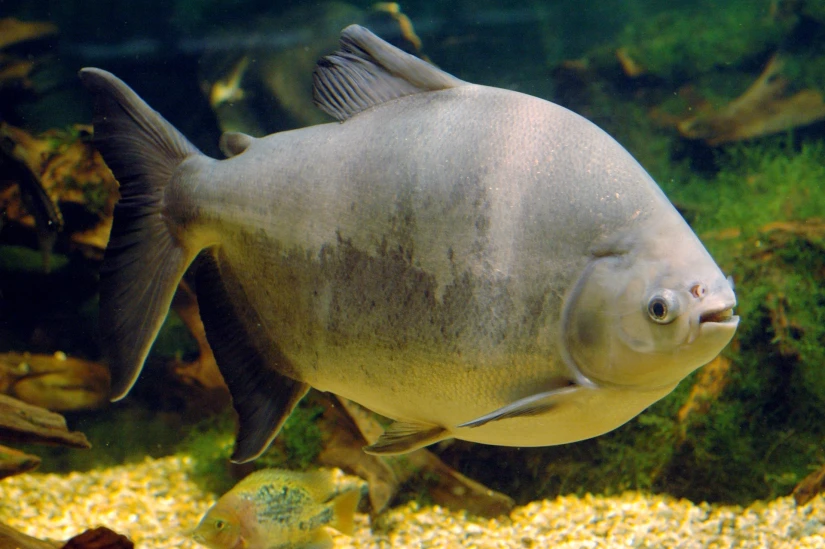
The piranha is one of today’s most ferocious carnivores. They hunt in schools of 30 or more fish, sporting teeth so sharp that they are often used as razors by South American Indians. If they lose a tooth, a complete new set of teeth quickly emerges from the gum. So what would piranhas eat in a perfect world where there was no death? The answer may be found in the pacu that looks so much like a piranha that misidentification is common. While piranhas are known as basically carnivorous, pacus are primarily vegetarian. They are satisfied with eating aquatic plants and fruit that have fallen in the water. It would appear from the genetic evidence that piranhas and pacus belong to the same created kind and that pacus are closer to the original, vegetarian type. After man’s fall into sin, genetic mutations became a reality. Mutations in the original piranha kind, coupled with a shortage of vegetation to eat, may have led some of the original created kind to begin scavenging carcasses. Eventually, some of the kind became the piranha we know today. Not because of upward evolution, but because of degeneration of the original kind.
Genesis 1:30 “And to every beast of the earth, and to every fowl of the air, and to every thing that creepeth upon the earth, wherein there is life, I have given every green herb for meat: and it was so.”
Prayer: I praise You, Lord, for so wisely providing for all Your creatures. Amen.
Ref: Creation, “Piranha.” Image: Piaractus sp (relative of piranhas), Zoo Leipzig 01, Tino Strauss, CC BY-SA 3.0, Wikimedia Commons.