Category: Insects
Speaker: Ian Taylor
Tags: devotional, creation science, christian radio, creation moments, ian taylor, biblical proof, today’s creation moment, blister beetle

Category: Insects
Speaker: Ian Taylor
Tags: devotional, creation science, christian radio, creation moments, ian taylor, biblical proof, today’s creation moment, blister beetle
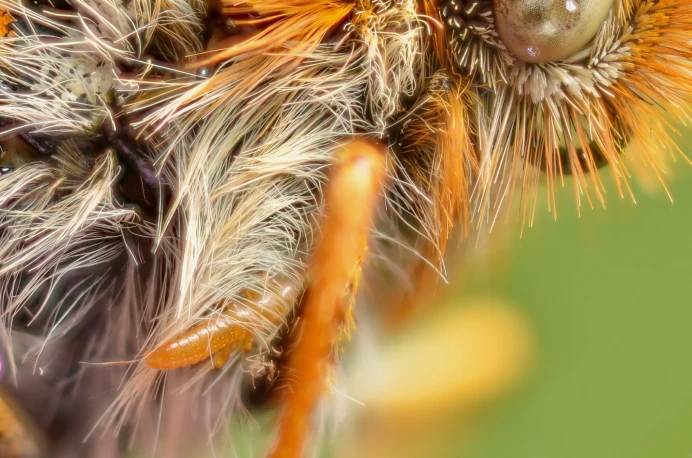
Blister beetles of California's Mojave Desert depend on solitary bees for their life cycle. The beetles, however, have nothing of interest to offer the bees.
Blister beetle larvae are so tiny that dozens of them can infest a solitary bee's body. Riding on the female bee, they transfer into the solitary bee's nursery when the female lays her eggs. There the beetle larvae eat the pollen that the mother has packed there for her hatchlings. Once they pupate into wingless adults, the blister beetles then need a male bee to carry them to a female so the next cycle of life can begin. To attract a male bee, large numbers of the beetles pile together into a clump that looks like a female bee. They will hold this shape for up to 2 weeks, waiting for a male bee to show interest. Researchers have also concluded that while in this position the beetles also generate the scent of a female bee ready to mate! Once a male bee gets close enough, the tiny beetles jump on his body. When he mates with a female, the beetles transfer to her body and wait for her to lay eggs. Scientists are amazed that the beetles, which are not social insects, are smart enough to work together to fool the male bees.
Obviously, the beetles did not design this clever strategy by themselves. The cooperation they show for their survival was designed and programmed into them by their wise Creator, perhaps to show us how important working together is for survival.
2 Corinthians 1:11
“Ye also helping together by prayer for us, that for the gift bestowed upon us by the means of many persons thanks may be given by many on our behalf.”
Prayer: Lord, help Your people work together for the good of Your kingdom. Amen.
Ref: Science News, "Ah, my pretty, you're...#&! a beetle pile!" Image: Triungulin on a butterfly (5739202307), Gilles San Martin from Namur, Belgium, CC BY-SA 2.0, Wikimedia Commons.