Category: Insects
Speaker: Ian Taylor
Tags: creation science, bees, radio broadcast, creation moments, today's creation moment, ian taylor, daily creation science, amber fossils

Category: Insects
Speaker: Ian Taylor
Tags: creation science, bees, radio broadcast, creation moments, today's creation moment, ian taylor, daily creation science, amber fossils
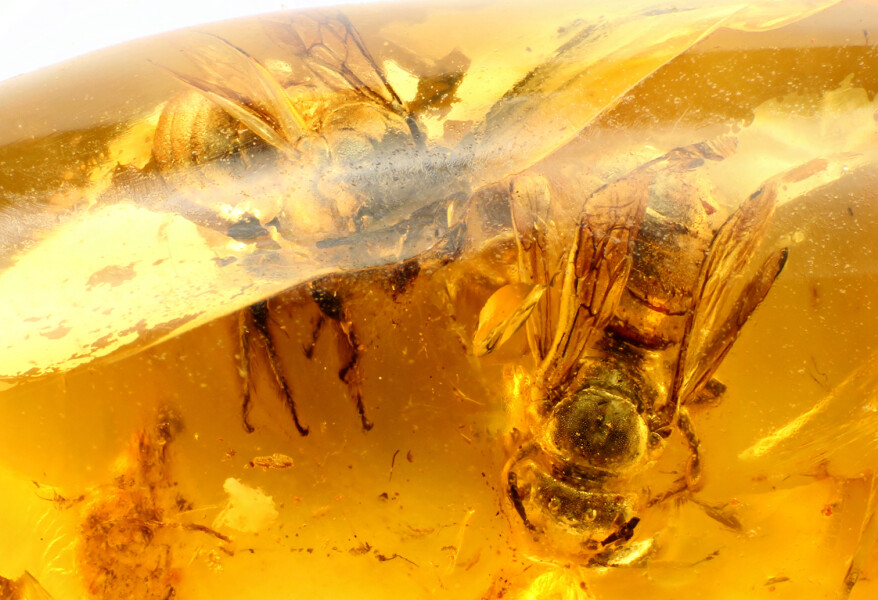
According to the Bible, God created the land-living insects, and that would include the bees, on day six of creation. This was just three days after He created the flowering plants. According to evolution, bees evolved from a simpler insect after the pollen-bearing plants had developed. The specialized bee and its complex social structure was thought to have taken a long time to evolve.
Creationists, who believe the time line of events laid out in Scripture and reject inflated evolutionary years, were not surprised when a bee was found preserved in amber which evolutionists said was many millions of years older than the oldest known bee. The almost perfectly preserved bee is like modern bees and can even be identified as a worker. Not only does this show that bees, with all their superb specializations, were around much earlier than ever thought by evolutionists, it also shows that they were around for some time before this specimen lived. In fact, the evolutionist who reported the findings admitted that there is a real problem explaining how bees could have developed nearly at the same time as pollen-bearing plants.
As creationists, we have no such problem. Bees were created, fully formed, only a few days after pollen-bearing plants. Science has shown us once again that the biblical history makes more sense than the evolutionary story of history.
Genesis 1:25
“And God made the beast of the earth after his kind, and cattle after their kind, and every thing that creepeth upon the earth after his kind: and God saw that [it was] good.”
Prayer: Dear Father, the whole creation shows forth Your glory. Open the eyes of those who are blind to Your fingerprints in the creation so that ultimately they may be led to know You and Your forgiveness through Jesus Christ. In His Name. Amen.
Ref: Origins Research. Fall/Winter. Image: Ctenoplectrella phaeton ("40-48 million-year-old" bees), Gonzalez & Engel, CC BY 3.0, Wikimedia Commons.