Category: Insects
Speaker: Ian Taylor
Tags: creation science, radio broadcast, creation moments, today's creation moment, ian taylor, daily creation science, assassin bug

Category: Insects
Speaker: Ian Taylor
Tags: creation science, radio broadcast, creation moments, today's creation moment, ian taylor, daily creation science, assassin bug
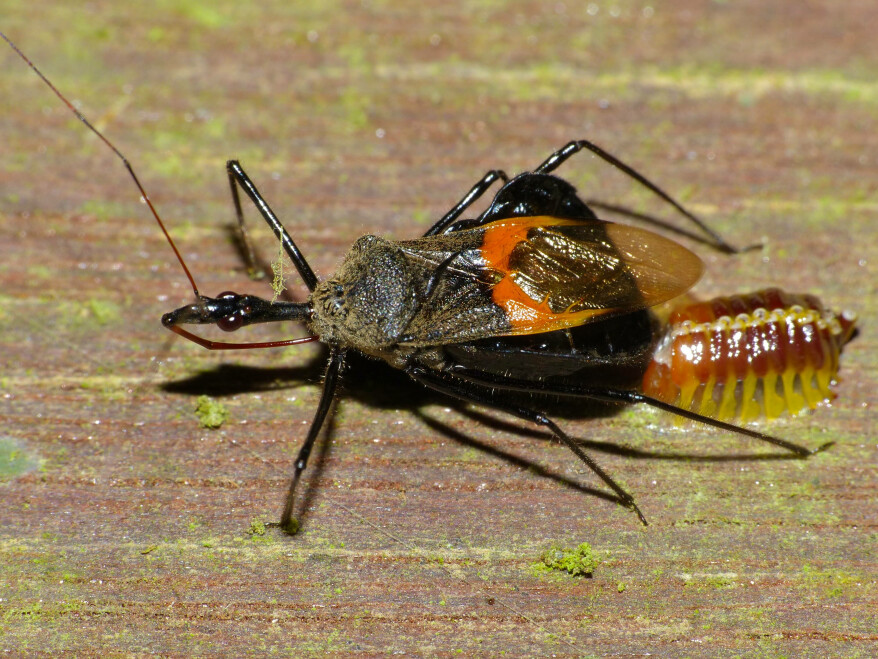
Christians have often been accused of being naïve when they claim to see the evidence of intelligent design in nature. But sometimes even those who believe in evolution concede that we can learn a lot by studying nature.
Dr. Thomas Eisner, of Cornell University, pointed out during an interview that “every single new idea in chemistry has come not from the minds of chemists, but from nature.” In other words, even our greatest chemists go to the creation to learn their science.
Take the female assassin bug’s use of chemistry, for example. The female assassin bug will rub the resin of the camphor plant on her belly until she has a good store of it on her. Then, when she lays her eggs, she carefully coats them with the resin. It took chemists some time to learn that the resin acts in the same way as do mothballs against moths – it keeps ants from eating her eggs. So the female assassin bug has shown chemists a new ant repellent!
The reason that God’s hand is so evident in the creation is because He wants all people everywhere to know that He exists as a personal, intelligent Being. Once that is established in people’s minds, He seeks to draw them to a personal relationship with Himself through His Son, Jesus Christ.
Romans 1:20
“For the invisible things of him from the creation of the world are clearly seen, being understood by the things that are made, [even] his eternal power and Godhead; so that they are without excuse.”
Prayer: Heavenly Father, I give thanks to You that You have sought me through the gospel and worked saving faith in Jesus Christ within my heart and mind. In Jesus’ Name. Amen.
Ref: Jane E. Brody. “Bug Lover Explores Nature’s Subtle Chemistry.” The New York Times. Image: Assassin Bug (Reduviidae) female laying eggs, Bernard Dupont, CC BY-SA 2.0, Wikimedia Commons.