Category: Insects
Speaker: Ian Taylor
Tags: worldview, devotional, creation science, christian radio, honeybees, honeycomb, creation moments, ian taylor, biblical proof, today’s creation moment

Category: Insects
Speaker: Ian Taylor
Tags: worldview, devotional, creation science, christian radio, honeybees, honeycomb, creation moments, ian taylor, biblical proof, today’s creation moment
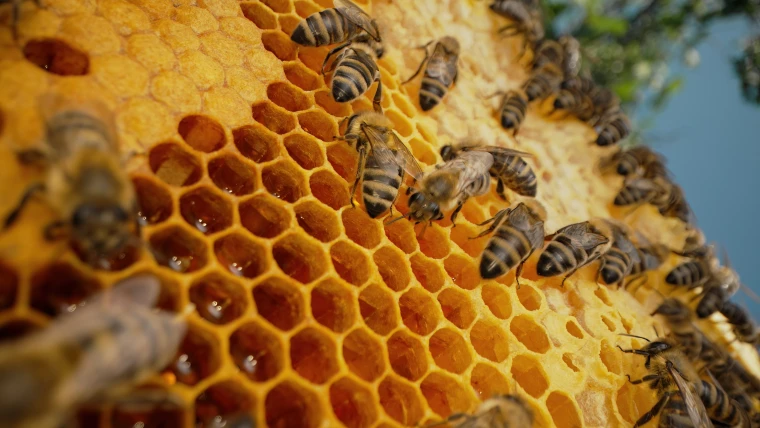
The amazing structure of the honeycomb has fascinated scientists for thousands of years. In the third century, the astronomer and geometer Pappus of Alexandria became the first to offer an explanation for why the honeycomb has a hexagonal shape.
Pappus explained that only three shapes could serve as candidates for a honeycomb cell—the triangle, the square, and the hexagon. Any other shape would leave wasteful open spaces between the cells. Pappus noted that the hexagon holds more honey in the same space than either a square or a triangle. It also takes less wax to build, and the shared sides of the hexagonal cells reduce wax usage even further.
It was not until the development of modern calculus that scientists could fully appreciate the shape of the caps at the end of the honeycomb cells. Each cell is capped with a pyramid composed of three rhombuses. Complex mathematics shows that this shape, too, requires the least amount of wax for construction. It also allows honeycomb cells to be butted up against each other without wasting space.
Modern scientists who accept evolution talk about the design of the honeycomb as a great accomplishment by the bees. However, the more sensible conclusion is obvious. The ten-sided prism of the honeycomb cap is a magnificent testimony to the mathematical wisdom of the Creator Himself!
Job 11:7-9
“Canst thou by searching find out God? canst thou find out the Almighty unto perfection? It is as high as heaven; what canst thou do? deeper than hell; what canst thou know? The measure thereof is longer than the earth, and broader than the sea.”
Prayer: Only You, Lord, could have invented mathematics and then taught it to the bees! Your wide generosity to all creatures enriches and blesses our lives even more. Amen.
REF.: The mathematics of the honeycomb. Science Digest.