Category: Archaeology, Insects
Speaker: Ian Taylor
Tags: creation science, radio broadcast, creation moments, today's creation moment, ian taylor, daily creation science, amber spider web

Category: Archaeology, Insects
Speaker: Ian Taylor
Tags: creation science, radio broadcast, creation moments, today's creation moment, ian taylor, daily creation science, amber spider web
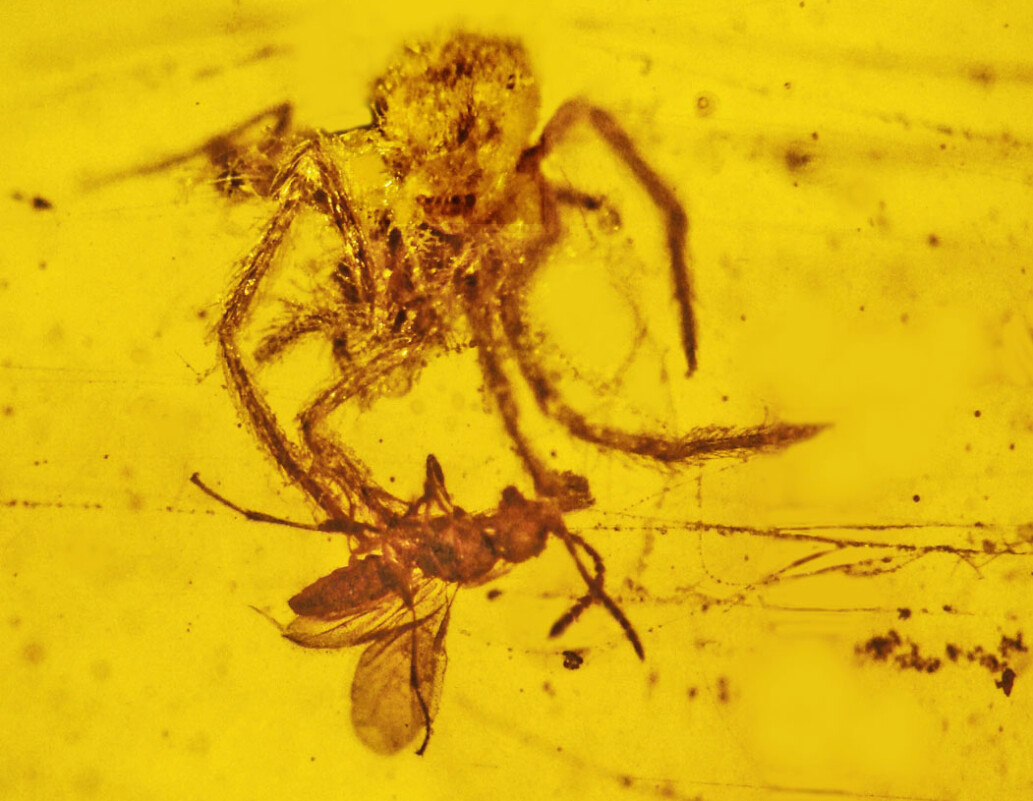
Scientists recently examined a well-preserved spider web encased in amber. It is the oldest example of a spider web in existence and was declared to be 110 million years old.
The researchers were eager to find out what the specimen might teach them about spider evolution. The web consisted of 26 strands of silk preserved in the amber while the pattern of the web appeared to be just like that of the modern orb-weaving spider. Three insects that were held by the web when it was encased in amber were also preserved. Interestingly, these three insects – a wasp, a fly, and a mite – are the same three insects that are most often caught by modern orb spiders. Today’s orb spiders place drops of glue along their web to capture their prey. The composition of the ancient glue and the modern glue was the same; however, it turned out that the ancient spider had applied the glue in a slightly different way from its modern cousin. From this small detail, the researchers tried to spin an evolutionary tale about this spider. Mankind, the world over, uses different techniques to achieve the same purpose.
The fact remains that the ancient spider’s web design and way of making a living were identical to that of modern spiders. There was certainly no evidence of evolution here.
Job 8:13-14
“So are the paths of all that forget God; and the hypocrite’s hope shall perish: Whose hope shall be cut off, and whose trust shall be a spider’s web.”
Prayer: Lord, help me to more clearly see Your hand in Your creation and remember Your mercies to me every day. Amen.
Ref: Science News, S. Perkins, “Sticky Subjects.” Image: Nephila burmanica attacking cascoscelio incassa in Burmese amber, Oregon State University, CC BY-SA 2.0, Wikimedia Commons.