
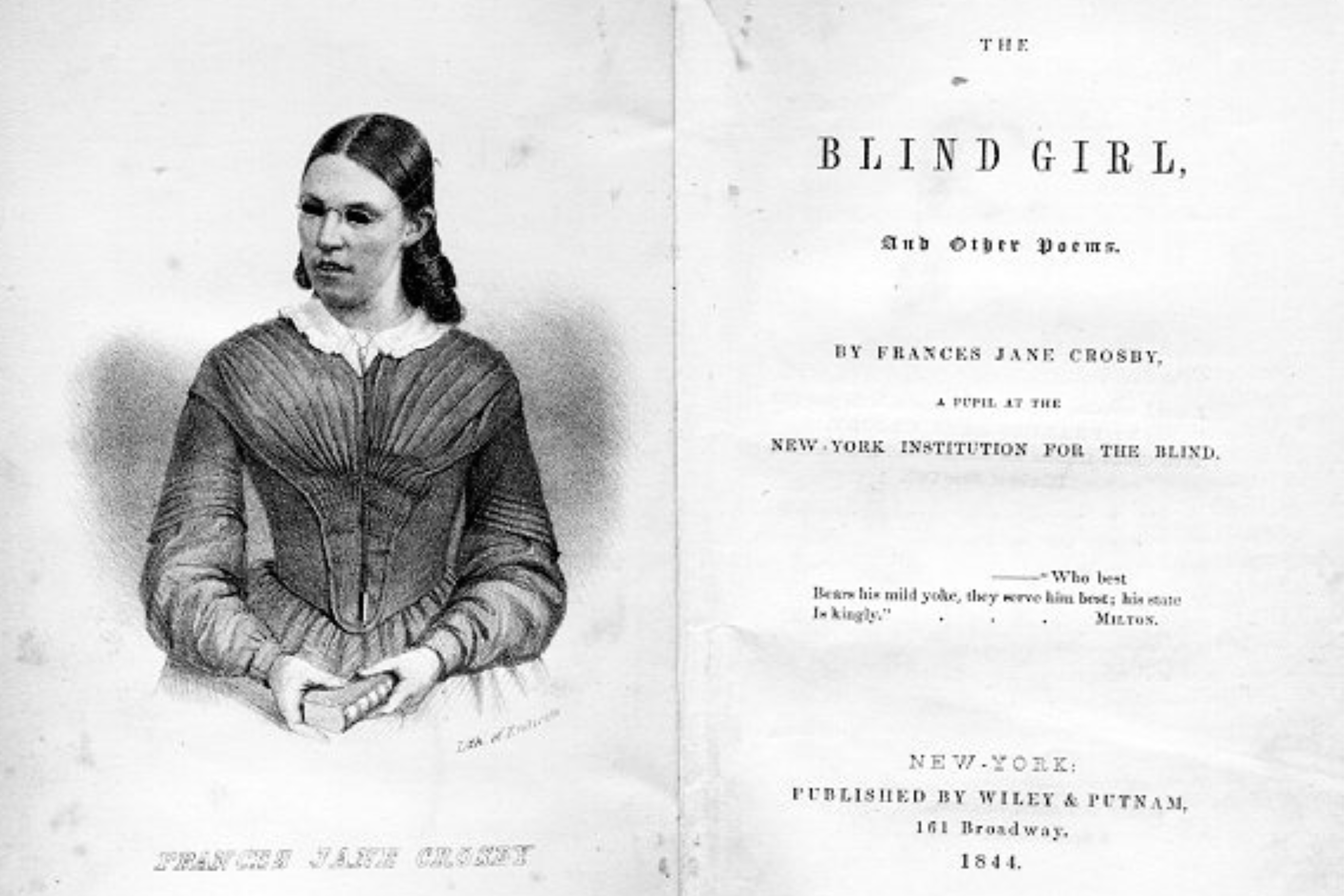
Born a normal, healthy baby, Frances (Fanny) Crosby (1820-1915) developed an inflammation of the eyes. At about the age of six weeks, her doctor mistakenly thought that the application of hot mustard poultices over her eyes would help to reduce the swelling. But what resulted was that little Fanny was blinded for life.
You might think that she had a reason to be bitter. Maybe so. In the secular world of today, she and her parents would likely have sued and won a big settlement. And although she still wouldn't have had her eyesight, she would at least have had a big bank account.
But her godly parents and grandparents taught her to believe that her blindness could be a blessing. And she did not become bitter, angry, or full of self-pity. At age eight years she wrote the following poem, which expresses her triumph over her handicap:
"Oh what a happy child am I, Although I cannot see.
That while I am in this world, contented I will be.
How many pleasures I enjoy, that other people don't.
To weep and sigh because I am blind, I cannot and I won't."
- Frances Crosby, "The Blind Girl and Other Poems", 1844
Blind people have an extra ability to enjoy the senses of touch, smell, and hearing. And Fanny learned to distinguish many different trees, flowers, and birds with her other senses. Fanny Crosby became a Christian, and a most incredible testimony to God's grace at work in the life of a human being. She loved to read the Bible, and memorized large portions of it, including the entire New Testament.
She became a prolific writer of poetry and hymns. Fanny Crosby wrote more than 9,000 poems and verses, including 6,000 hymns. Many of the best-loved hymns to this day are hers, including "Blessed Assurance Jesus is Mine" and "All the Way My Savior Leads Me", among others. These popular titles convey the optimism in Christ which gave her strength. She became well known to many famous people in her day. And she often joked about her blind condition, saying to people, "Don't you pity me, I've never seen sin". She would also say, "The first face that my restored eyes will ever behold, will be that of Jesus Christ". Fanny Crosby’s amazing ability to rise above her handicap and to spread such warmth, love, and positive influence was because of her hope in Christ.
Indeed, the Bible tells Christians that we have this blessed hope: "For our conversation (citizenship) is in heaven, from whence also we eagerly wait (look) for the Savior, the Lord Jesus Christ; Who shall transform the body of our humble state into conformity with the body of his glory..." (Philippians 3:20-21). In spite of her disability, and in fact because of it, Fanny Crosby's was a truly radiant, inspirational, and eternally fruitful life.
Mankind's stubborn and irrational rejection of God's free gift and genuine hope in Christ indicates our deeply entrenched bondage to sin. Sin in the heart of man (a fundamental rejection of the authority of God and our responsibility to Him) is the root, the cause of our present “cursed” existence. "The heart of the sons of men is full of evil, and madness (insanity) is in their heart while they live (throughout their lives)" (Ecclesiastes 9:3).
Cleansing from the root problem of sin is a personal process achieved deep in the heart through faith in the Savior, Jesus Christ, Son of God, who paid the penalty for sin for each of us through His death on the cross. "The axe must be put to the root" (Luke 3:9) if you want to deal effectively with the bad growth. The gospel message is that this cleansing from sin; this axing out of the root cause of our cursed existence, is freely offered to all through Jesus Christ. And the result is eternal life and eternal fellowship with God. This is where one can find genuine optimism in a dying world. This is the "blessed hope" (Titus 2:13) which "we have as an anchor of the soul, both sure and steadfast, and one which enters within the veil (the Holy of Holies)" (Hebrews 6:19).
The world without God is without hope. Man without God is without hope. Our hope lies in God our Creator, who therefore transcends our world. Even in the face of nuclear annihilation or other disaster, and the inevitability of our own deaths, a Christian need not fear because a Christian is reconciled to God; to the Creator Who is much greater than the creation which testifies of Him!
The Christian can look forward to sharing the glory of God in the day of reckoning. And in view of worldly pursuits which can sidetrack a person from what's truly important, the Christian is exhorted to keep in focus the key to life. "Seek those things which are above, where Christ is, seated at the right hand of God. Set your affection on things above not on things of this earth; for you have died and your life is hidden with Christ in God," (Colossians 3:1-3). This is what Fanny Crosby did, in the midst of the darkness in which she lived.
This is where real hope lies, both for now and forever! A phrase attributed to Edmund Burke is, "the moral imagination". This is essentially the creative vision of a high ideal of goodness and virtue which must necessarily approach the brilliance of a Holy God. It discerns love, justice, courage, greatness, and order beyond the confines of self- interest and indulging appetites.
Setting our "minds on things above" is in effect having a "moral imagination". Such a vision is what lifts human beings above the level of mere existence moment to moment. Such a vision is what brings true freedom and the possibility of an absolutely wonderful inheritance!
"Blessed be the God and Father of our Lord Jesus Christ, which according to His abundant mercy hath begotten us again unto a lively (living) hope by the resurrection of Jesus Christ from the dead, to (obtain) an inheritance incorruptible (imperishable) and undefiled, that fadeth not fade away, reserved in heaven for you, who are kept by the power of God through faith unto a salvation ready to be revealed in the last time" (1 Peter 1:3-5).
Isn't it foolish not to seek the "imperishable inheritance" when everything else in this decaying and dying world is perishing? As someone has said, "He is no fool who gives what he cannot keep to gain what he cannot lose".
Ref.: Blumhofer, E.L., Her Heart Can See: The Life and Hymns of Fanny J. Crosby, Wm B. Eerdmans Publishing Co, 2005.

Login To Leave Comment