
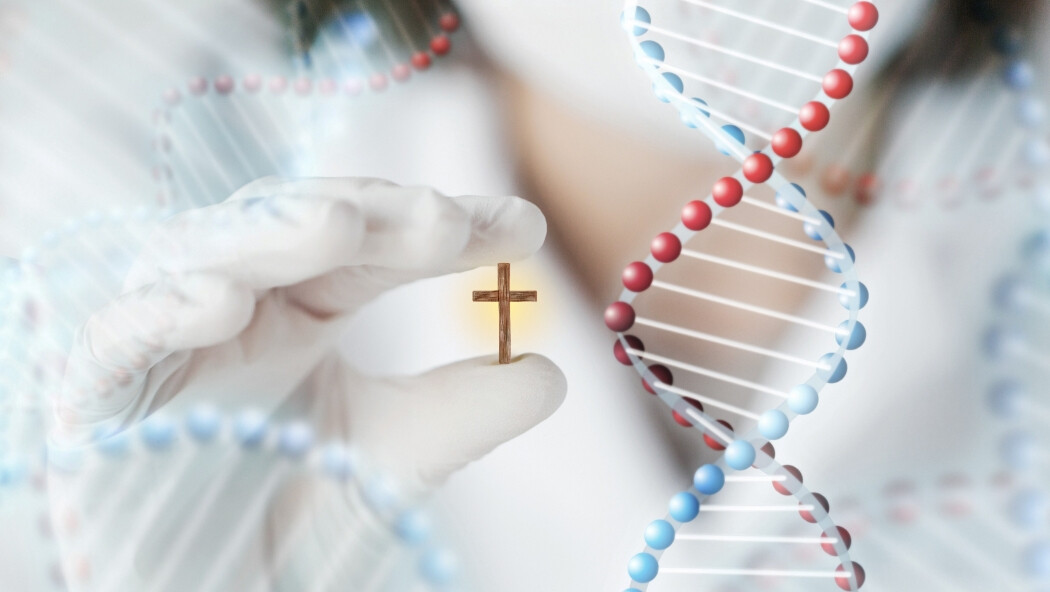
Was the original sin of the first man some sort of genetic mutation to his reproductive DNA? Weird idea? Yet the Bible says that the sin of Adam resulted in an inheritance of sin and death for all of Adam’s offspring (Rom 5:12-14; 1 Cor 15:21,22) and that Adam’s offspring are indwelt by sin at conception (Psalm 51:5). This has led to the doctrine of “original sin”.
Scoffers mock the idea of original sin and instead argue for an idea of “original innocence”. How could a brand-new helpless baby, totally unexposed to a dysfunctional civilization, come into the world a sinner? In fact, the whole foundation of a pagan worldview is the premise that our natures are not corrupt. If we could just get back to a pure and pristine nature, such a worldview says, and unload the inhibitions, obsessions, hang-ups, and narrowness that we learn from civilization, other people, and religion, we could solve the world’s problems. Just get in sync with the natural cycles, feel the earth’s vibrations, appease the spirits of the trees, harmonize with the cosmos, and live by the creed of tolerance.
You may laugh at these expressions, but this is pantheism, which C.S. Lewis says is “the natural bent of mankind”. The world exchanges the glory of the incorruptible God for an image in nature (Rom 1:23).
The Bible says that nature is not innocent or pure, but fundamentally corrupted. We live in a world under the curse of death, decay, and futility because of sin (Gen 3:17, Rom 8:20-21). Every parent sees their little newborn babe grow from doing nothing but sleeping and eating, to become a selfish, demanding little person who doesn’t need to be taught how to grab things from his playmates or throw a temper tantrum. Character must be taught. Sin comes naturally.
And the more we learn about the powerful determination of genetics, on behavioral traits as well as physical traits, the more we should be impressed with the perfection of the Biblical worldview. Studies of identical twins separated from birth, and who therefore have different upbringings, have repeatedly correlated personality, IQ, and behavior to genetics. There is evidently a powerful determinant of more than just physical features correlating to organic molecules in the form of genes.
Genetic mutagens are known to modern science, which affect heritable traits, with chemical toxins and radiation specifically capable of producing inherited physical damage in human beings. Such inheritable mutagens are called teratogens. They do this by damaging the DNA of the cells that produce sperm and egg (the gametes). There are mechanisms within our bodies for genetic repair, but this does not always happen.
The Apostle Paul sees sin indwelling the members of his body and warring with the Law in his mind (Rom 7:14-25). And the Bible says the Christian’s struggle is between “spirit” and “flesh” for control of the “soul” (Gal 5:17). The flesh of all men has somehow been corrupted by the original sin of the original man, as with some genetic teratogen leaving a genetic marker for sin. The Bible also says that even Christian believers “groan” and “wait eagerly” for complete “adoption as sons, the redemption of our bodies” (Rom 8:23). Our “genetically” flawed flesh must eventually be replaced in the future, in order for us to fully cast aside the problem of sin and enter into “the freedom of the glory of the children of God” (Rom 8:21).
The Bible is consistent on this doctrinal application to genetics in the circumstances surrounding the Messiah, Jesus. Mary the mother of Jesus, gave birth to “a second Adam” (1 Cor 15:45) who was “conceived by the Holy Spirit” (Matt 1:20) and tempted as ourselves and Adam was, “yet without sin” (Heb 4:15). Here was a new “representative man” who did not already have nor aquire the “genetic flaw”. This “seed of the woman” would crush the head of the serpent (Satan), as prophesied years earlier in Genesis 3:15.
“As in Adam all die…” (1 Cor 15:22). The “sin gene,” so to speak, would be transmitted from Adam through all human males, since only the male sperm donates either an X (female) or Y (male) chromosome, determining the sex of the child, and thus affecting all mankind post Adam. It would be in virtually every nucleus of every cell of our “flesh” as part of our particular genetic blueprint. Eve would have received the effects of her sin (death) from the forbidden fruit, but she does not need to donate the inherited “sin-inducing teratogen” to be biblically and scientifically correct. Thus, by omitting Eve as the progenitor of original sin in these texts, the Bible is genetically correct. As the story of the birth of Jesus unfolds thousands of years after the Garden of Eden and the fall of mankind into sin, a genetic significance of the language “seed of the woman” becomes clear. And it does not require the divinity of Mary, the mother of Jesus.
Conceived by the Holy Spirit, God could quite clearly “complete” the genetic composition of Jesus in the womb of Mary, making Him representative of all races and individuals as was Adam, the first human being. Thus, since Christ would have had a master set of genes, genes from which you and I could be derived, (literally a “second Adam”), the scripture can say and mean quite plainly, “...knowing this, that our old self was (actually) crucified with Him...” (Rom 6:6). Christ would be genetically representative of all mankind, in preparation for His substitutionary death on the cross for all mankind (1 Pet 3:18, 2 Cor 5:18-21, Heb 9:28). One can even marvel that by having the physical traits of a middle eastern Jew, He would have the looks of a racial composite of all ethnic groups. Someone with a “master set” of genes would arguably look like a person from the Middle East.
The Bible is consistent and “actually scientific” in its claims and presentation of the grand story of sin and redemption - from the beginnings of mankind in Genesis through the birth and death of Jesus Christ atoning for our sin on the cross! Although just scratching the surface, modern genetics, applied within biblical doctrine, provides clarification to theological truths. Our fundamental depravity is a problem we cannot rid ourselves of on our own, because it is deeply embedded like a genetic marker. And it causes us to deeply require the redemptive work of Jesus Christ, who has richly provided it for us by representing each one of us on the cross, where God the Father could properly judge our sin through His death on our behalf! No wonder the Bible can say that as we trust Him as our Savior, we have “an anchor of hope for our souls which is both sure and steadfast” (Hebrews 6:19).
Won’t you trust Him today?!


Login To Leave Comment